Best Roofing Felt for Shed Projects

A shed roof usually starts leaking in the same predictable places – along the edges, around overlaps, or where cheap felt has dried out and split after a few seasons. If you are trying to choose the best roofing felt for shed use, the right answer is not simply the lowest price roll on the shelf. It depends on the shed size, how long you need the roof to last, and whether you want a quick repair or a proper replacement.
For most UK sheds, the best option is a heavy-duty bitumen roofing felt designed for outdoor buildings rather than lightweight economy felt. The difference in service life is usually worth paying for. A better grade felt is thicker, more tear-resistant during fitting, and less likely to fail early in exposed weather.
What makes the best roofing felt for shed roofs?
A shed roof does not need the same specification as a large flat roof, but it still has to deal with standing water, wind uplift, frost and summer heat. That is why material quality matters more than many buyers expect.
The best roofing felt for shed roofs is usually one that balances durability, ease of installation and realistic cost. For a basic garden shed used for storage, a standard green mineral cap sheet system can be perfectly suitable if fitted properly. For workshops, garden offices, larger timber buildings or sheds in exposed areas, it often makes sense to move up to a tougher, longer-lasting felt system.
Thickness is one of the first things to check. Thin, budget rolls can be tempting for a fast job, but they are more likely to wrinkle, tear around fixings and degrade sooner. A heavier felt with a reinforced core gives better handling during installation and generally stands up better over time.
The finish also matters. Sanded felt can be used in some layers, but mineral-finished felt is often the better top layer because it gives added protection against weathering and UV exposure. On a shed, that extra protection can make a noticeable difference.
The main types of shed roofing felt
There is no single felt that suits every project. What works on a small bike store may not be the best fit for a large timber workshop.
Economy felt
This is the lowest-cost option and is often used on very basic sheds or short-term repairs. It can be enough for a quick replacement where budget is the deciding factor, but there is usually a trade-off in lifespan. Economy felt is thinner and can be more prone to splitting, especially if the roof deck is uneven or the shed is exposed to wind.
If you are only looking for the cheapest way to keep a shed dry for now, it can do the job. If you would rather fit it once and leave it alone for years, it is rarely the best long-term choice.
Traditional bitumen felt
This is the standard choice for many garden buildings in the UK. It offers a good middle ground between cost and performance and is widely used on sheds, kennels, summerhouses and similar structures.
A bitumen-based felt system with a proper underlay and cap sheet is a dependable option for most domestic applications. It is familiar to installers, straightforward to work with, and available in finishes that suit garden buildings without looking overly industrial.
Torch-on felt
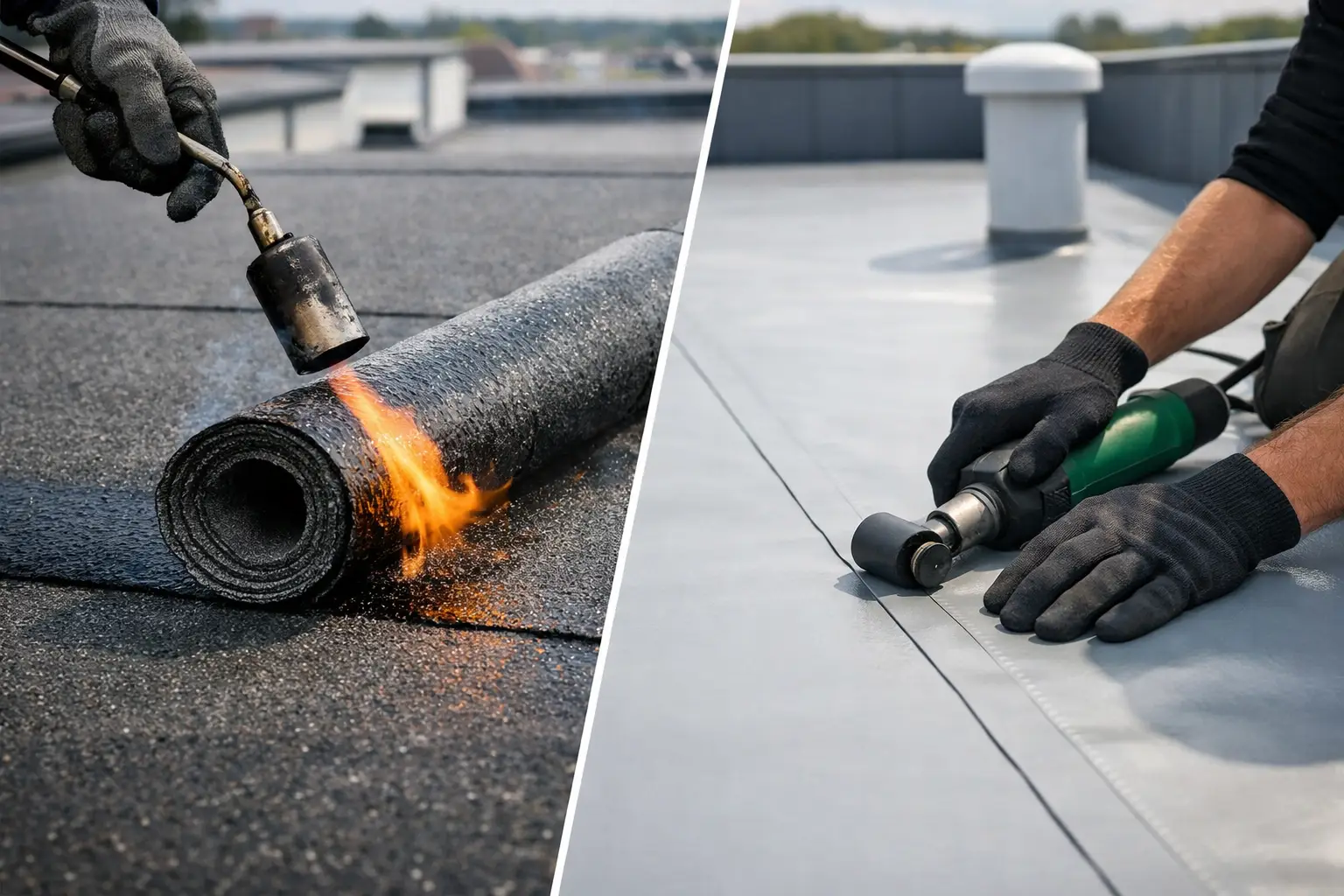
Torch-on systems are tougher and can offer a longer service life, but they are not always the first recommendation for every shed owner. They are more suited to those with roofing experience or professional installers, because fitting involves heat and more controlled application.
For larger sheds or more demanding outbuildings, torch-on felt can be an excellent choice. For a small DIY job, it may be more than you need, and not everyone will want the complexity of hot works around a timber structure.
Self-adhesive felt
Self-adhesive options can be a practical route for DIY users who want a cleaner, simpler installation method. They remove the need for torching and can help achieve a neater finish if the roof deck is prepared well.
That said, self-adhesive systems still need careful fitting. They are not a shortcut for poor preparation, and they tend to perform best when applied in the right temperatures and with proper pressure across the full surface.
How to choose the right felt for your shed
Start with the building itself. A small garden shed used for storing tools does not need the same roofing build-up as a heavily used garden office or workshop. If the shed contains valuable equipment or has electrics inside, spending a bit more on a better felt system usually makes good sense.
Next, consider exposure. A sheltered shed behind fencing and hedges will generally face less weather stress than one on an open site. In windy or coastal areas, stronger materials and more secure fixing methods become more important.
Roof deck condition also affects the result. Even the best felt will struggle if it is laid over rotten timber, raised joints or old fixings pushing through the surface. A clean, dry, sound deck gives the felt the best chance of lasting.
Then there is lifespan. Some buyers only need a practical repair to get through the next few years. Others want a shed roof that will stay reliable with minimal maintenance. That difference should guide the product choice. The cheapest felt is rarely the most cost-effective if you have to replace it again far sooner.
Installation matters as much as the felt itself
A good product can still fail early if it is fitted badly. Most felt problems on sheds come from poor detailing rather than the material alone.
Edge treatment is one of the biggest weak points. If the felt is not fixed securely at the perimeter, wind can catch it and start lifting it. Once that happens, water usually follows. Proper drips, overlaps and edge protection all help prevent that kind of failure.
Overlaps need care too. Too little overlap risks water ingress. Too much can create awkward build-up and an untidy finish. Following the manufacturer guidance matters here, especially if you are using a multi-layer system.
Fixings and adhesive choice also make a difference. Some shed felts are designed to be nailed, some bonded, and some installed as part of a complete built-up system. Mixing methods without checking compatibility can shorten the life of the roof.
This is often where trade-quality materials show their value. They tend to be designed as part of a system, so the layers and accessories work together properly rather than leaving the installer to guess.
Should you repair or replace the existing felt?
If the damage is limited to one small split or a local patch, a repair can be enough. That is especially true if the rest of the felt is still flexible, well-bonded and not heavily weathered.
If the surface is cracking in several places, the edges are lifting, or the felt has become brittle across the roof, replacement is usually the better option. Patching old felt repeatedly can turn into false economy. You spend time and money on repairs but still end up with a roof that is unreliable in heavy rain.
Where the deck underneath shows signs of damp or rot, lifting the old covering and checking the timber is the sensible approach. Covering over a failing substrate rarely ends well.
Best roofing felt for shed buyers who want value
For most buyers, value is not about buying the cheapest roll. It is about getting a felt that fits the building, installs properly and gives a reasonable service life for the money spent.
If you are buying for a straightforward domestic shed, a quality bitumen felt with a mineral finish is often the safest all-round choice. It offers better weather protection than very light shed felt and is still accessible in terms of cost and fitting.
If you are roofing a larger or more important outbuilding, stepping up to a more durable felt system is often worthwhile. The extra spend at the start can reduce future maintenance and help avoid the cost of replacing damaged boards or stored contents later on.
For trade users, consistency matters just as much as price. A felt that handles well, lays flat and performs predictably on site saves time. For homeowners, the priority is usually confidence that the roof will stay watertight through typical UK weather without constant patching.
That is why practical product support matters. A dependable supplier such as Quality Roofing Supplies Ltd can help narrow the choice based on roof size, fixing method and expected lifespan, which is often more useful than trying to compare product labels alone.
Common mistakes when choosing shed felt
One common mistake is buying purely by roll price without checking thickness or intended use. Another is assuming all roofing felt is much the same. In reality, there can be a big gap between a lightweight budget felt and a proper heavy-duty system.
It is also easy to underestimate the accessories. Adhesives, clout nails, edge trims and correct underlay layers all play a part in the finished roof. Missing one piece of the system can compromise the result.
Finally, many shed owners wait too long. Once water gets beneath old felt, the damage can spread into the deck and structure. Replacing tired felt early is usually simpler and cheaper than dealing with rotten timber afterwards.
A shed roof is a small job compared with many roofing projects, but the material choice still matters. Pick a felt that suits the building, fit it properly, and you are far more likely to end up with a roof that stays quiet, dry and dependable through the British weather.
Share This Article
Follow Us
Latest Articles
August 8, 2026
August 6, 2026
August 4, 2026
