Best Rooflights for Flat Roofs Explained

A dark flat-roofed room can feel finished on paper but disappointing in practice. Choosing the best rooflights for flat roofs is usually what turns an extension, garage conversion or commercial space from usable into genuinely bright, comfortable and worth the investment.
The right rooflight is not just about letting in more daylight. It affects thermal performance, ventilation, privacy, maintenance and how straightforward the installation will be. For trade buyers and homeowners alike, the best option depends on the roof build-up, the room below and how the rooflight will perform over time in British weather.
What makes the best rooflights for flat roofs?
The short answer is suitability. A rooflight can look good in a product photo and still be the wrong choice for the job if the upstand height is wrong, the glazing specification is too basic or the opening style does not match the room.
In most flat roof projects, the best rooflights balance five things well – daylight, insulation, weather resistance, durability and ease of fitting. Price matters too, of course, but the cheapest unit is not always the most cost-effective if it creates fitting issues or underperforms in winter.
For most domestic and trade applications in the UK, a good flat roof rooflight should offer tough glazing, reliable seals, solid kerb compatibility and a design that sheds water effectively. That usually means choosing purpose-made flat roof units rather than trying to adapt products intended for other roof types.
Fixed or opening rooflights
One of the first decisions is whether you need a fixed rooflight or an opening model. Fixed rooflights are often the simplest and most cost-effective option. They suit spaces where the main goal is daylight, such as hallways, stairwells, kitchens and open-plan extensions that already have enough ventilation elsewhere.
Opening rooflights add another layer of function. In bathrooms, kitchens and rooms that trap heat, being able to vent warm air can make a real difference to comfort. Manual opening units can work well where the rooflight is within reach, while electric options are better for higher ceilings or larger spaces.
There is a trade-off here. Opening units usually cost more and involve more components, which means more to consider during installation and maintenance. Fixed models are generally cleaner in appearance and simpler to fit, so if ventilation is not needed, they are often the more practical choice.
When fixed rooflights are usually best
Fixed units are a strong choice for projects where reliability, simplicity and clean sightlines matter most. They are commonly used on flat roof extensions, single-storey rear additions and rooms where windows or doors already provide background airflow.
Because there are fewer moving parts, they can also be a sensible option for buyers who want lower long-term maintenance.
When opening rooflights make more sense
If the room below tends to build up moisture or excess heat, opening rooflights are often worth the extra cost. They are especially useful in kitchens, utility rooms and bathrooms, where natural ventilation supports day-to-day comfort and helps reduce condensation.
For commercial settings or larger domestic spaces, electrically operated units can also improve access and convenience.
Glazing matters more than many buyers expect
If you are comparing the best rooflights for flat roofs, glazing specification deserves close attention. It has a direct effect on energy efficiency, comfort and safety.
Double glazed units are common and suitable for many projects, but the overall quality of the glass and unit construction still matters. Toughened outer panes and laminated inner panes are often preferred for safety and durability. This combination helps the rooflight cope with impact while also offering protection if the glass is ever damaged.
Solar control glass can be useful in south-facing extensions or any room that gets strong direct sun. Without it, a space can become too warm in summer, especially if the rooflight is large. On the other hand, if the room below is naturally cool or gets limited sunlight, standard clear glazing may be the better value option.
Privacy is another factor. In bathrooms or overlooked areas, tinted or obscure glazing may help, although this can reduce the brightness slightly. As with most rooflight choices, it depends on how the room is used.
Flat glass vs dome rooflights
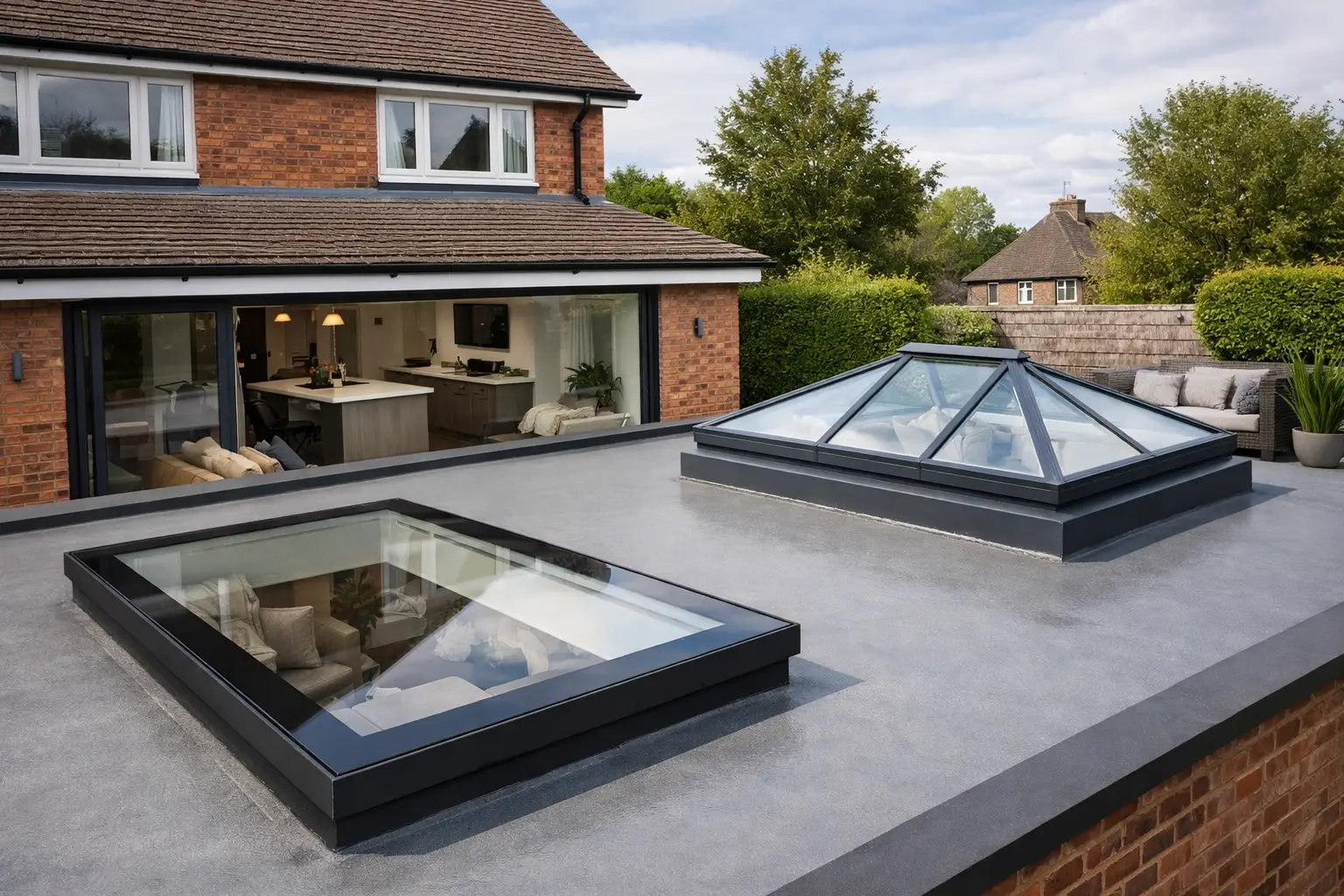
This is one of the most common comparisons. Flat glass rooflights are popular because they offer a modern, low-profile finish and tend to suit contemporary extensions well. They give a clean external appearance and usually maximise visual appeal from inside too.
Dome rooflights are often chosen for practical reasons. They can be lighter, cost-effective and very good at shedding rainwater. For some commercial buildings, outbuildings and utility spaces, they are a sensible solution where function matters more than architectural style.
Flat glass units are often preferred in higher-spec domestic projects, but that does not make dome rooflights inferior. If the budget is tighter or the rooflight is being fitted in a less visible area, a dome can be a very practical choice.
Kerb-mounted vs direct-fit options
Many flat rooflights are designed to be fitted onto a builder’s upstand or proprietary kerb. Getting this detail right is essential. A quality rooflight can still become a problem if it is paired with the wrong kerb height or an incompatible roof finish.
Kerb-mounted rooflights are widely used because they offer flexibility across different flat roof constructions. They can also simplify replacement work where an existing upstand is already in place. The key is checking the manufacturer’s size requirements carefully and making sure the finished upstand is square, weatherproof and correctly insulated.
Some buyers focus heavily on the visible glass size and forget to check the structural opening size. That can lead to delays on site, especially if the roof deck has already been cut. For trade installers, accurate measurements avoid wasted time. For homeowners, they prevent expensive ordering mistakes.
Size, light levels and room proportion
Bigger is not always better. A large rooflight can bring in impressive daylight, but if it is oversized for the room, it may create glare or overheating. A smaller unit in the right position can sometimes perform better than a larger one placed poorly.
For kitchens and open-plan living spaces, multiple rooflights are often worth considering instead of one oversized unit. This can spread daylight more evenly across the room and create a better visual balance on the roof.
In narrower rooms or corridors, a single well-positioned rooflight may be enough. The best approach is to think about where the daylight needs to fall during normal use rather than choosing purely by headline dimensions.
Details that separate a decent product from a dependable one
Not all flat rooflights are built to the same standard. The frame finish, thermal breaks, seals and overall build quality all matter once the unit is exposed to years of weather.
A well-made rooflight should feel like a roofing product, not just a glazing product adapted for the roof. That means dependable weathering details, strong edge protection and a design suited to standing water, wind and temperature changes. In the UK, that practical difference matters.
It is also worth checking cleaning and maintenance requirements. Some rooflights are easier to keep looking good than others, particularly on lower-pitched flat roof areas where dirt can build up more quickly.
How to choose the best rooflights for flat roofs on your project
The most practical way to choose is to work backwards from the job. Start with the room below. Does it need only daylight, or daylight plus ventilation? Is privacy a concern? Will the space overheat in strong sun? Then look at the roof build-up, opening size and finish requirements.
For a straightforward extension where appearance matters and ventilation is already covered, a fixed flat glass rooflight is often the best all-round option. For a bathroom or kitchen with limited airflow, an opening rooflight may justify the extra spend. For utility areas, commercial spaces or more budget-sensitive jobs, a dome rooflight can still be an excellent fit.
The best buyers also consider installation from the outset. A product that arrives quickly, matches the roof specification and is simple to fit can save more money on site than a lower ticket price ever will. That is why trade-quality supply matters.
If you are unsure between two options, it usually helps to choose the one that best matches the actual use of the room rather than the one with the longest feature list. Extra features are only valuable if they solve a real need.
Quality Roofing Supplies Ltd serves both trade customers and homeowners with practical, performance-focused roofing products, so the aim should always be the same – buy a rooflight that suits the roof, the room and the installation properly.
A good rooflight should do its job quietly for years: bring in the right amount of light, keep the weather out and make the finished space feel better every day.
Share This Article
Follow Us
Latest Articles
August 8, 2026
August 6, 2026
August 4, 2026
